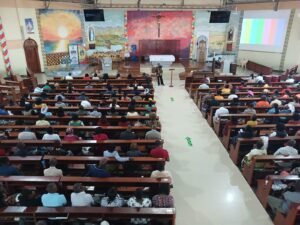
Mental health conversations among young people can no longer be confined to counselling rooms, hospitals or occasional awareness campaigns. They must reach young people where they live, learn, play, create and connect. This is the thinking behind RTT Sports & Talents Academy, an initiative of RTT that uses sports, talents, arts, life skills and mental-health education as platforms for advocacy, prevention, healing and empowerment.
RTT believes that every young person has something valuable within them—a talent, a skill, a dream, a story or an ability waiting to be developed. Our task is to create safe spaces where that potential can flourish while equipping young people with the mental and emotional skills they need to navigate life’s challenges.
This approach is supported by growing global recognition of the relationship between physical activity, sport and mental wellbeing. WHO notes that regular physical activity can improve mental health, quality of life and wellbeing, while sport can provide a platform for health promotion and awareness. UNICEF has also highlighted the use of arts, sports and play as approaches for strengthening mental-health and psychosocial support for children and young people.
FROM THE TRAINING GROUND TO THE MENTAL HEALTH CONVERSATION
At RTT, a football pitch is more than a place to score goals. A dance session is more than entertainment. An art exhibition is more than creativity. They are entry points into conversations about mental health.
Our model begins with training and psychoeducation.
Young people participating in different teams and talent groups are exposed to structured mental-fitness sessions throughout the year. These sessions address topics such as:
- Emotional intelligence
- Self-awareness and self-esteem
- Emotional regulation
- Discipline and responsibility
- Resilience and coping with adversity
- Peer pressure and decision-making
- Addiction and substance-use prevention
- Suicide awareness and prevention
- Healthy relationships
- Communication and conflict management
- Digital wellbeing
- Stress management
- Seeking help and supporting peers
- Purpose, hope and goal setting
The aim is to ensure that mental fitness becomes part of the training—not an afterthought.
WHO’s guidance on adolescent mental health similarly emphasises interventions that build resilience, strengthen emotional regulation, reduce risk-taking behaviours and create supportive social environments.
ALL PLAY FOR MENTAL HEALTH
RTT’s philosophy is simple:
We don’t just train players; we build mentally fit individuals.
The young people may come to RTT because they love football, dancing, music, art or another talent. They stay because they discover community, purpose, confidence, friendship and a safe space to express themselves.
Football teaches teamwork, discipline, communication, perseverance and how to manage winning and losing. These lessons extend beyond the pitch into school, family, relationships and future workplaces. WHO also recognises sport and physical activity as important contributors to social integration, self-esteem, cognitive development and overall wellbeing.
Through talent and arts, young people are also given a language through which they can express emotions and experiences that may be difficult to communicate verbally.
A song can tell a story.
A painting can communicate pain.
A dance can express freedom.
A poem can give words to an experience.
A football match can build belonging.
And a conversation after training can sometimes become the first step towards seeking help.
FROM TEAMS TO TOURNAMENTS: A YEAR-LONG JOURNEY
RTT Sports & Talents Academy is not built around a single tournament. It is designed as a year-long mental-health journey.
Different teams and talent groups participate in continuous training, psychoeducation, mentorship and skills development. Throughout the year, RTT facilitates engagements that gradually move participants from awareness to knowledge, knowledge to practice, and practice to healthier choices.
The journey culminates in tournaments, talent showcases and an awarding ceremony that brings together the different sports, talents and arts.
The tournament therefore becomes more than competition.
It becomes a platform for:
Mental-health awareness → talent expression → peer connection → stigma reduction → resilience → celebration → referral and healing.
At the Talent & Awards Day, participants showcase their creativity around different mental-health themes through music, dance, drama, poetry, visual arts, digital creativity and other forms of expression.
In this way, mental health becomes something young people can talk about, create about, perform about and celebrate.
FIGHTING STIGMA THROUGH PARTICIPATION
One of the biggest barriers to mental-health support is stigma.
Many young people fear being labelled “weak”, “mad”, “problematic” or “different” when they talk about emotional struggles. Others do not recognise that what they are experiencing may require support.
RTT uses sport and talent to change this narrative.
Instead of beginning with:
“You have a mental-health problem.”
we begin with:
“Come and play. Come and create. Come and learn. Come and talk.”
The mental-health conversation then becomes normalised within the team.
Young people learn that asking for help is not weakness and that mental wellbeing deserves the same attention as physical wellbeing.
This is particularly important because globally, approximately one in seven adolescents aged 10–19 experiences a mental-health condition, while stigma and limited access to support remain significant barriers.
SPORTS ALONE IS NOT ENOUGH: HEALING IS PART OF THE MODEL
RTT’s approach recognises that advocacy must be connected to support and healing.
Where young people present with emotional distress or other concerns, RTT’s wider mental-health services provide opportunities for counselling, therapy, psychosocial support, psychoeducation and appropriate referral.
This creates a continuum:
PREVENT → IDENTIFY → SUPPORT → REFER → HEAL → RESTORE
The football field or talent space becomes the point of connection, while professional mental-health support provides an avenue for deeper intervention when needed.
This integrated approach is important because prevention, early identification and access to appropriate care need to work together. UNICEF similarly emphasises prevention, early intervention, screening, referral and youth-friendly mental-health support.
BUILDING RESILIENCE—ONE GAME, ONE TALENT AT A TIME
Resilience is not simply the ability to “be strong.”
It is the ability to face difficulty, recover, learn, adapt and continue moving forward.
Sports naturally provide opportunities to develop resilience.
A player loses a match and learns to recover.
A team faces disappointment and learns to regroup.
A young dancer forgets a performance and learns to try again.
An artist receives criticism and learns to improve.
A young person who once lacked confidence gets onto a stage and discovers, “I can do this.”
These experiences can become building blocks for emotional resilience.
RTT deliberately uses these moments to reinforce mental-health lessons about failure, persistence, self-belief, emotional regulation and hope.
SKILLS FOR INCOME GENERATION: FROM TALENT TO PURPOSE
RTT Sports & Talents Academy goes beyond recreation.
Young people need hope and economic purpose.
Unemployment, idleness and lack of opportunities can contribute to frustration, hopelessness, vulnerability to harmful peer influence and engagement in risky behaviours.
Therefore, RTT is progressively incorporating skills for income generation and entrepreneurship into the Academy.
Young people can be exposed to skills related to:
- Digital creativity
- Photography and videography
- Fashion and design
- Art and crafts
- Events and entertainment
- Sports-related opportunities
- Entrepreneurship
- Communication and media
- Other practical livelihood skills
The objective is to help young people see that their talent can become a skill, and their skill can potentially become an income-generating opportunity.
This contributes to mental wellness by strengthening purpose, self-efficacy, independence, hope and future orientation.
CLIMATE ACTION FOR MENTAL WELLNESS
Another distinctive component of RTT Sports & Talents Academy is environmental care and climate action.
Through initiatives such as Green Champs, tree planting, environmental clean-ups and community conservation activities, young people are encouraged to take responsibility for the spaces in which they live.
Why connect climate action with mental health?
Because healthy environments support healthy communities. Outdoor activity also creates opportunities for physical movement, social connection, purpose and positive engagement.
Instead of spending unstructured time in environments that may expose them to negative influences, young people can participate in activities that give them a sense of ownership, responsibility and contribution.
The message is:
Healthy minds. Healthy bodies. Healthy communities. Healthy planet.
This is part of RTT’s commitment to holistic health.
HOLISTIC HEALTH: THE HEART OF THE SPORTS & TALENTS ACADEMY
RTT does not view mental health in isolation.
Our understanding of holistic health brings together:
Physical Health
Through football, walking, exercise, sports and active recreation.
Mental Health
Through psychoeducation, counselling, therapy, emotional regulation and mental-fitness training.
Emotional Health
Through emotional intelligence, self-awareness, resilience and healthy expression.
Social Health
Through teamwork, friendships, peer support and positive community relationships.
Economic Wellbeing
Through skills development, entrepreneurship and income-generating opportunities.
Environmental Wellbeing
Through tree planting, clean-ups and climate-conscious activities.
Purpose & Personal Development
Through talent discovery, mentorship, leadership and goal setting.
This holistic approach reflects the reality that a young person’s wellbeing is influenced by multiple dimensions of life. WHO and UNICEF similarly emphasise supportive environments, life skills, physical activity and psychosocial support as important components of adolescent wellbeing.
THE BIGGER GOAL: FIGHTING SUICIDE AND ADDICTION
At the heart of RTT Sports & Talents Academy is a difficult but urgent mission:
TO HELP PREVENT SUICIDE AND ADDICTION AMONG YOUNG PEOPLE.
We believe prevention cannot wait until a young person reaches crisis.
It must begin early—with knowledge, connection, purpose, resilience, healthy relationships, supportive adults, positive peer networks and accessible mental-health services.
Sport and talent provide the platform.
Mental-health education provides the knowledge.
Counselling and therapy provide support.
Skills provide purpose.
Environmental action provides responsibility.
Community provides belonging.
Together, these create protective spaces where young people can discover that their lives have value, their voices matter and their future is worth investing in.
WHO identifies self-harm among major causes of death among adolescents and young adults globally and notes that early substance use is associated with increased risk of dependence and other problems later in life.
OUR VISION IS A GENERATION THAT IS MENTALLY FIT
RTT Sports & Talents Academy is ultimately about changing the question from:
“What is wrong with this young person?”
to:
“What can we do to help this young person thrive?”
We want to see young people who can play without fear, create without shame, speak without stigma, seek help without embarrassment, learn with purpose, earn with dignity and live with hope.
Our tournaments are therefore not simply about winners and losers.
Our Talent & Awards ceremonies are not simply about trophies.
Our training sessions are not simply about football skills.
Every game, every song, every dance, every artwork, every conversation and every skill learned is part of a bigger mental-health movement.
At RTT, we believe every talent can become a pathway to mental wellness.
**We play for mental health.
We create for mental health.
We learn for mental health.
We connect for mental health.
We heal for mental health.**
ALL PLAY FOR MENTAL HEALTH.
Written by Esther Kamaku
Director & Clinical Psychologist – RTT
RTT: Advocating for Mental Health Through Sports, Talents and Community Action